Category: Small Mysteries Of Everyday Life

  • The Last Biscuit Standoff

    The Last Biscuit Standoff

    Many of us have been in a situation where beautifully presented, delicious biscuits are placed on the table.

    It doesn’t matter whether it’s a family gathering or a business meeting.

    Everyone enjoys them. They disappear quickly.

    Except the last one.

    The last one stays.

    And somehow… it lasts.

    Like a lonely lantern on the sea, quietly igniting internal battlefields.

    All the biscuits were identical.
    They tasted exactly the same, and you know that.

    But this last one?

    The longer you stare at it, the more it feels as if secret ingredients are constantly being added. In your imagination it becomes the most delicious biscuit in the world.

    And you know the others are thinking exactly the same.

    You observe them.

    Suddenly you feel a little like Patrick Jane from the TV show The Mentalist. You begin to think you can read everyone’s mind.

    In psychology, this might be called a kind of cognitive synchronization – when several people focus on the same thing, their thoughts begin to follow the same path.

    Is this theory scientifically proven?

    Maybe.

    But it explains the situation surprisingly well.

    So you sit there and think about what to do.

    There are several possible scenarios.

    You could eat the biscuit and save everyone from tension and silent internal wars.

    But do you really want to be that hero?

    Or do you suddenly remember something your mother said when you were a child:

    “Don’t take the last biscuit. Someone else might want it more.”

    Your Mum

    Now the heroic act suddenly feels more like greed.

    Another option is diplomacy.

    You could break the biscuit in two and offer it to two colleagues.

    But what if there are more people around the table?

    Who should be chosen?

    And if you give it away completely, you may feel like you sacrificed something precious, even if you did it willingly.

    A more strategic mind might consider a different approach.

    According to the famous rule “keep your friends close and your enemies closer,” you could choose the colleague you like the least and politely encourage them to take the biscuit.

    No regret. No sacrifice.

    Deep down you know it’s the last thing you should do… but the idea is tempting.

    Most often, however, something else happens.

    You simply become tired of the internal conflict and decide to let others solve the situation.

    But they are equally tired.

    So eventually people leave the room.

    The lights go off.

    Everyone forgets.

    Almost everyone.

    The biscuit remains there like a small artifact, a silent witness to the mysterious battles people fight inside themselves.

    A monument to human politeness.

    Until someone quietly comes back.

    They look around.

    No witnesses.

    And they take the biscuit.

    And honestly?

    They will probably be the most satisfied person in the building.

    Case #03 — Biscuit

    Observation:
    Humans do not compete for the last biscuit.

    They negotiate its existence.

    Secondary observation:
    The person who takes the biscuit last
    was probably thinking about it the entire time.

    Empty biscuit plate with crumbs on a table as guests leave the room while a detective notebook and magnifying glass rest nearby.
    Evidence after the social standoff. The last biscuit has disappeared, leaving only crumbs, proof that someone eventually made the decision.
  • Milk in the Fridge

    Milk in the Fridge

    There are many things that can disappear from a fridge without causing any emotional reaction.

    But there is one sentence that immediately creates concern in almost every household.

    “We’re out of milk.”

    And suddenly the panic begins.

    Discussion starts.
    Why is there no milk in the fridge?
    Who drank the last drop without saying a word?
    Who is responsible for the fact that it’s finished?

    The whole perfectly built family structure starts collapsing and it’s not about milk anymore.

    The future suddenly looks dramatic.

    Morning without coffee will ruin the whole day. Now you need to plan a strategy. Where to get coffee on the way to work? Where to park? Which coffee shop is closest? What time do you need to wake up to get there, order coffee, and still arrive at work on time?

    And what about breakfast?

    Another strategy session begins. Maybe pancakes? But pancakes also need milk.

    Think.

    Yes, there are other breakfast options, but somehow everyone in the family accepts only the one that includes milk. So you really have no choice.

    It was supposed to be a perfectly planned evening. You’re already in your comfortable pajamas. Makeup removed. The Netflix series is waiting.

    But now?

    Dress up again. Makeup again. Get in the car. Go buy milk.

    While you are in the supermarket, you suddenly remember that there are about fifty other things missing in your house.

    Two hours later you leave the shop with a full basket.

    When you get back home, it’s already too late to unpack everything. Straight to bed. The good thing about Netflix is that you can watch it anytime.

    But you wanted to watch it today. Yesterday and the day before and many days before that something always happened in the evening.

    Today was supposed to be the day.

    It was also supposed to be a perfect evening for a slow conversation with your husband. Instead, there was drama, and now you probably won’t talk for three days.

    All because of one simple thing.

    There was no milk in the fridge.

    Another scenario involving milk is when you suddenly discover there is no milk exactly when a guest asks for it.

    This is a truly awkward moment.

    First, you must confess that you are not well organized enough to keep milk in the house. Your image of a perfect host suddenly collapses. Perhaps your friendship will collapse too.

    Your guest politely says black coffee is perfectly fine.

    But you are already in strategy mode.

    Quick decision: jump in the car, buy milk, come back.

    But how can you leave someone alone in your house? Maybe you ask them to come with you.

    The trip to the shop and back takes just enough time for your guest to say:

    “Actually, I should go. It was really nice seeing you.”

    And now you feel like you disappointed them so badly they may never visit again.

    Lesson learned the hard way.

    From this moment on, there will always be milk in your house.

    Not one carton.

    Three minimum.

    Milk in the fridge.
    Milk in the cupboard.
    Milk in the pantry.

    And not just one kind of milk.

    Every possible kind:

    Oat milk.
    Vanilla milk.
    Lactose-free milk.
    Full-fat milk.
    Low-fat milk.
    No-fat milk at all.

    Because your guests might prefer different types.

    Milk, after all, is clearly the foundation of family civilization.

    Case #02 Milk
    Investigation complete.
    Conclusion:
    Civilization does not run on electricity.
    It runs on milk in the fridge.


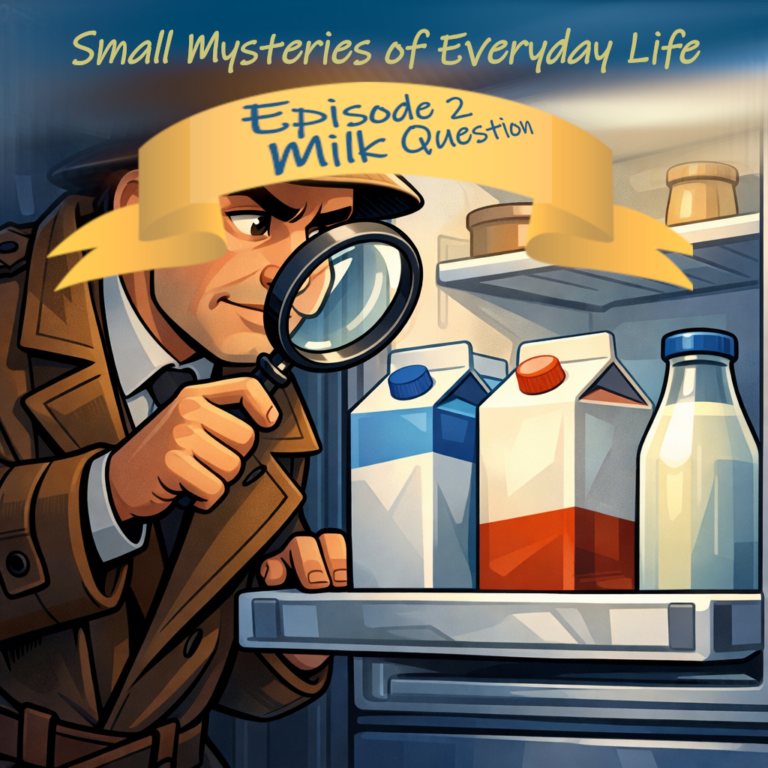
    Cartoon detective examining milk cartons inside an open refrigerator with a magnifying glass.
    The moment of discovery. The investigation reveals an unexpected constant in almost every household: milk in the fridge.
  • The Curious Case of Missing Supermarket Window

    The Curious Case of Missing Supermarket Window

    Sometimes you can walk somewhere many times and accept reality as it is, without questioning it. Until one day you enter a supermarket in a philosophical mood and start asking random questions.

    Why did I actually come here?
    Yes, we have all been there.

    Do I really need anything?
    Did I pay for the parking ticket, or will I manage to leave within the free time?

    And then, boom.

    Suddenly you notice something you have never noticed before.

    Why are there no windows in supermarkets?
    Why can’t we see the outside world once we enter a big mall?

    When you lose contact with the outside world, you start to feel much safer inside.

    Notice something: when you are at home or in the office and you look through the window and see beautiful weather outside, you naturally want to go out. It becomes harder to focus on the task inside.

    And that is exactly why supermalls avoid windows.

    When you lose contact with the outside world, you start to feel comfortable in an artificial environment. Lovely smells, warm light , everything makes you relax. You walk around looking at colorful things, putting them into your basket, and feeling a small wave of satisfaction with every product you decide to take.

    What was supposed to be a quick 10-minute visit slowly turns into almost two hours. And suddenly you are in a very good shopping mood.

    No duties outside.
    No responsibilities for a while.
    A safe haven inside the supermarket.

    And all of this begins with a small trick: removing the windows.

    Now the question is once you notice it, does anything really change?

    I don’t think so.

    For most people, shopping will still remain one of the most relaxing activities. This article is not about removing the pleasure of shopping. It’s simply about noticing the funny little things around us.

    The next time you enter a supermarket, the first thing you might do is look for a window.

    And you will probably realize there isn’t one.

    Every day we pass thousands of things without noticing them. But once we discover that something exists , or that something was removed on purpose ,we start seeing it everywhere.

    The world is full of small wonders for curious minds and attentive eyes.

    And you ? what obvious thing have you noticed recently that nobody else seems to see?

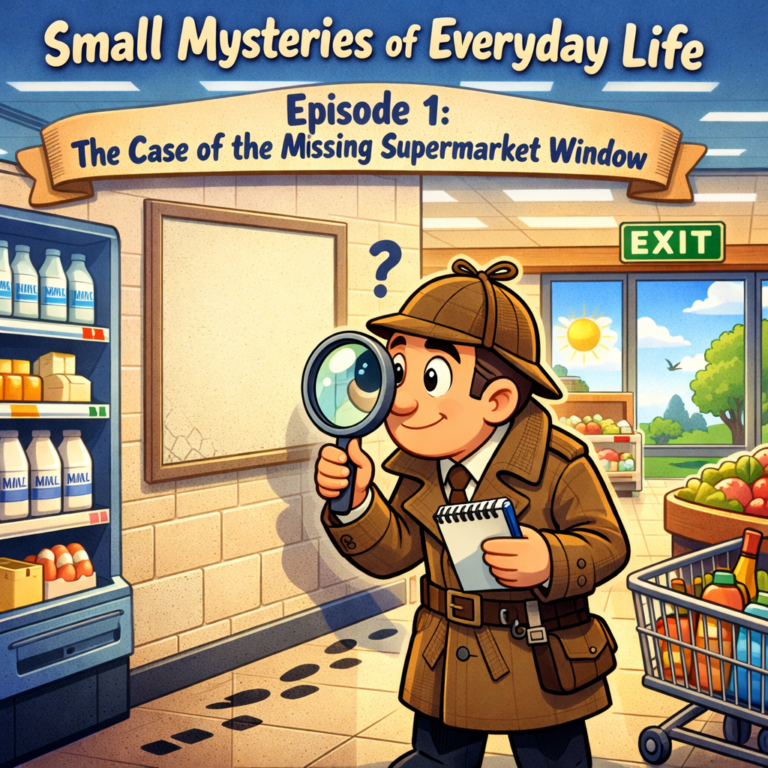
    After solving the supermarket window mystery, the detective returned home – only to discover another strange pattern. Milk. Always milk.